

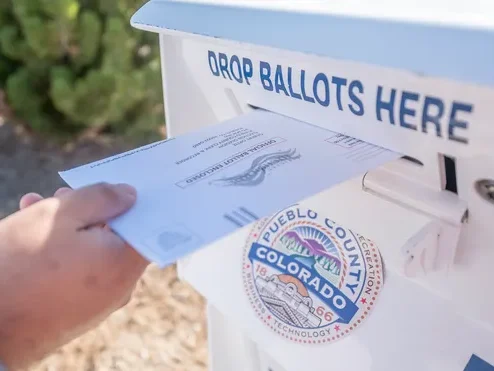


Last week, Initiative 177 — to enshrine the right for consumers to buy natural gas and for distributors and utilities to sell it — qualified for the general election ballot. The petition garnered 146,165 valid signatures, surpassing the required minimum, and drew signatures from at least two percent of registered voters in each of the 35 state Senate districts.
The text of the measure is only a few lines: 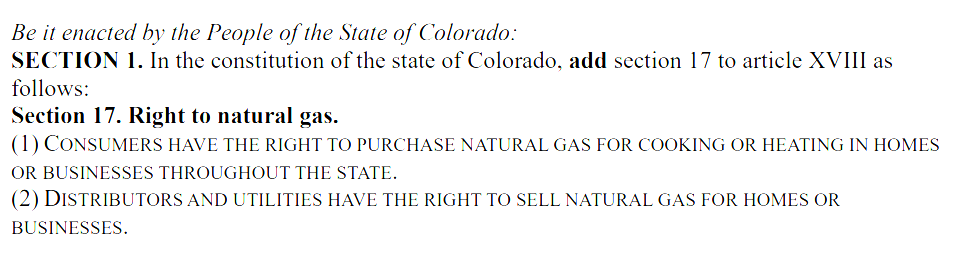
Because Initiative 177 amends the state constitution, it needs a 55 percent supermajority vote to pass, not just a majority. The measure has already encountered roadblocks. Democratic lawmakers made a late-session threat to put unspecified “guardrails,” on the measure, if passed, but pulled the attack days before adjournment.
During this debate, House Speaker Julie McCluskie, D-Dillon said that the initiative is “overly broad,” and “lacks clarity.” She posed the hard-hitting question: “If everybody has a right to natural gas, does that mean they can walk around with it in a container out on the streets?”
The last time that U.S. voters decided on a natural gas ballot initiative was Washington’s Initiative 2066, which was approved with 51.71 percent of the vote. The measure stops state and local governments, gas and utility companies, cities, and towns from prohibiting access to natural gas in several ways. However, a King County judge ruled it unconstitutional in March 2025 because the “body of the initiative is so broad and free ranging that it makes it hard to say with any precision what the general topic is.” The Washington Supreme Court heard oral arguments earlier this year and has not yet ruled.
Sound familiar? If Initiative 177 passes, expect similar arguments in court that will delay implementation of the amendment. However, the initiative has already cleared the Title Board’s single-subject review, which might make it harder to argue that the initiative is overly broad.
The initiative comes at a time when Colorado is cracking down on natural gas, despite some 1.9 million households using it. Xcel Energy has failed to meet its 2025 goal under the Clean Heat Plan, which will require gas utilities to reduce their greenhouse gas emissions 4 percent by the end of 2025 and 22 percent by 2030. The Public Utilities Commission’s (PUC) additional decision to extend the target to 41 percent reductions by 2035 will all but guarantee higher costs and force households off natural gas into electrification.
It isn’t clear that Initiative 177 would spare ratepayers from the Clean Heat Plan, but it could set up a constitutional showdown over Colorado’s policies to cut gas use. The Clean Heat Plan pushes customers onto electric heating by necessity and would require an “unprecedented, nearly overnight transformation” of the market. Courts may have to decide how far the state can go with mandates and infrastructure decisions to phase out natural gas without infringing on the new constitutional right.
A passed Initiative 177 would require Colorado’s courts to determine whether it preempts outright bans on natural gas hookups, put limits on policies like the Clean Heat Plan, or more. Initiative 177 gives Coloradans a direct way to stop the legislative march toward forced electrification by putting the right to choose natural gas in the state constitution, where lawmakers, the governor, and regulators will have to take notice.