

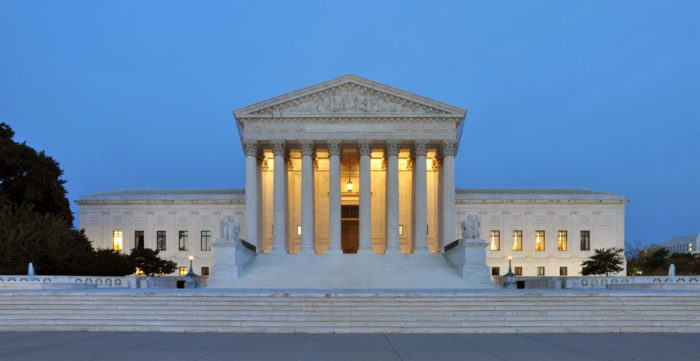


On October 5, eight Justices of the U.S. Supreme Court heard oral arguments in Suncor Energy (U.S.A.) Inc. v. County Commissioners of Boulder County (Suncor v. Boulder County). The case asks whether state and local governments can impose liability on American companies for emitting carbon dioxide and affecting global climate. Dozens of other jurisdictions have filed similar suits in state courts.
Justice Samuel Alito recused himself from the case a mere week before it was argued. Although the reason was not disclosed until after the arguments, he explained that he and his wife own individual stock in oil companies (ConocoPhillips and Phillips 66, neither of which is named in Suncor). If the Justices split 4-4, the case could be allowed to proceed to trial and a jury in a single U.S. county could hold companies liable for a global product.
After nearly two hours of oral arguments on Monday, the eight remaining Justices sent “mixed signals” on whether climate cases should be allowed to proceed in state courts. Boulder County argues that the lawsuit isn’t attempting to regulate greenhouse gas emissions. Rather, the production and marketing of fossil fuels by Suncor and ExxonMobil, while knowing and misrepresenting the risks, have caused or contributed to harms in Colorado, and the county seeks compensation for these harms — so the argument goes.
As the Wall Street Journal editorial board put it:
Several Justices sounded skeptical. “Is there anything anomalous in your mind to applying state law here to worldwide conduct?” Justice Neil Gorsuch asked. “No, I don’t think so,” Mr. [Kevin] Russell [attorney for Boulder] replied, comparing Boulder’s claims to a product liability lawsuit against an auto maker for a defective car.
This is an odd analogy since the county isn’t arguing that oil is defective. Far from it. Oil is vital to the economy and everyday living, and Boulder County hasn’t sought to ban it. Product liability suits also require plaintiffs to show they have suffered direct harm as a result of a particular defendant’s products. Boulder hasn’t done so.
The energy companies advance the argument that one state can’t regulate inherently interstate matters and that federal law has traditionally had oversight over interstate air and water pollution. Their lawyer, Kannon Shanmugam, described Boulder’s claims as an “unprecedented effort to use state law to regulate global conduct.”
Justice Elena Kagan seemed skeptical of that, arguing that the approach “appears to be based on the old 1990s tobacco suits” which had been allowed to proceed. But even Justice Kagan pointed out that “everything depends on this idea that the defendants are responsible for excessive emissions.” Chief Justice John Roberts agreed, and Justice Brett Kavanaugh said the Court’s precedents make it “crystal clear” that issues involving interstate air and water pollution are subject to federal preemption.
The lawyer for Boulder County admitted to Justice Clarence Thomas that under their arguments, there would be nothing stopping suits against large retailers; that could extend to gasoline, petrochemical manufacturers, and even dairy farmers, since cows emit methane. Roberts noted the “practical matter” of how it would work on the ground to manage a slew of 50 or so similar or identical lawsuits following on the heels of Suncor.
The Independence Institute joined two amicus briefs urging the court to take the case and again on the merits, arguing that one state cannot make national energy policy, and companies cannot be beholden to hundreds or even thousands of separate environmental agencies.
A ruling is due before the term ends next summer. If the Court ties, Colorado’s decision stands and the cases stayed in other states can resume. Boulder’s attorney told Justice Amy Coney Barrett that the suit would make the companies “internalize a portion of the cost of their activities.” That cost will ultimately land not just on Colorado consumers, but national and international customers.