


Colorado Public Radio (CPR) reported this week that Colorado Springs Utilities (CSU) wants to change its rules for “how solar customers are billed and credited.” The story details how rooftop solar owners feel duped and their regret over having invested in solar.
This isn’t a simple “utility-versus-solar-owners” story, though. Rooftop solar is currently paid more than it’s worth to the grid. Rooftop solar owners are subsidized by their non-solar neighbors because they avoid paying for utility infrastructure, which is still a cost that needs to be paid for by somebody.
CSU brought in outside consultants from the Brattle Group to estimate the cost shift from their rooftop solar owners to customers without solar. Across Utilities’ 11,000 rooftop solar customers, the 2025 annual cost shift was $4.3 million, at a cost of roughly $393 per solar customer per year. On average, each non-solar customer pays $21 per year. Brattle estimated that the cost shift would increase to $5 million in 2026 and $8 million in 2030 due to increased solar adoption and higher rates.
The cost shift exists because a consumer’s electricity rate subsumes the infrastructure costs of poles, wires, substations, and dispatchable plants. Solar customers “are not entirely self-sufficient,” because solar is missing-in-action at night and on cloudy days, but they buy fewer kilowatt-hours of electricity, so they avoid “their share of those fixed costs that those rates were designed to recover.” But solar customers still use infrastructure, as Utilities “must continue to maintain grid reliability and provide energy for when those customer-generated resources are unavailable.”
Compounding the problem is that CSU must pay for excess generation from the panels at the full retail rate, which is in abundant supply at midday. They do so at the full retail rate, which effectively cancels out what infrastructure costs the solar customers do pay for. Rooftop solar is only worth the utility what it saves in fuel, or the avoided cost of fuel, which is about a third of the retail rate.
CSU chief financial officer Tristen Gearhart told CPR that, “(Solar customers) are not paying for all of the infrastructure that they’re using during those peak times that we have to build.” He also points out that, “We typically see electrical use by solar customers is about 30% higher than non-solar customers, which makes sense. They’ve invested in solar panels and are trying to find electric devices they can use with those credits.”
Nothing changes for current customers until 2032, because CSU will keep current rates for customers established before April 1, 2027. The utility proposes two options, both with an estimated bill impact of about $38 per month at 2027 rates. The first adds a $1.00 daily grid access charge, moves solar customers to time-of-day pricing, and stops letting credits roll over indefinitely. Exported power still earns the retail rate, but power sent to the grid cheaply at midday no longer cancels one drawn back at peak hours. The second option keeps one-to-one retail rate credits and the monthly rollover but adds a demand charge set by the customer’s single highest 15-minute interval of grid use.
The state established net metering in 2005, with subsequent expansions of eligibility in 2018 and 2021, that requires excess generation from net metering be credited at the full retail rate. Because the law requires it to offer full retail rate compensation, what CSU can do is to try to rebalance other charges such that solar owners are paying for the infrastructure they use.
Net metering subsidies are regressive, as rooftop solar owners are wealthier than the non-rooftop customers underwriting them. Lawrence Berkeley National Laboratory (LBNL) puts the median 2023 income of solar adopters at $115,000, against $94,000 for owner-occupied households and $75,000 for all households, including renters, apartment dwellers, and lower-income families who can’t install solar.
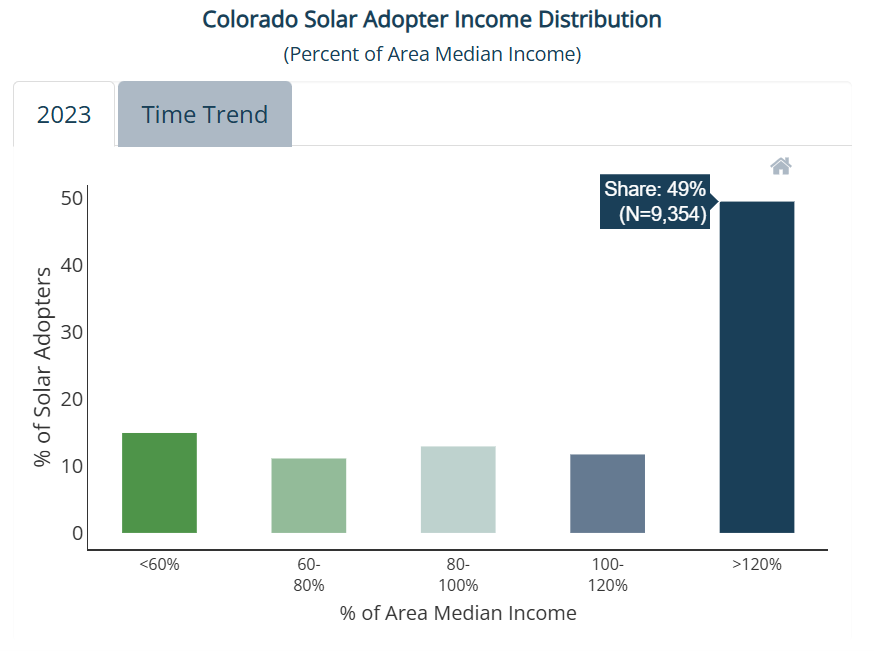
In 2023 in Colorado, LBNL estimates that 49 percent of solar adopters earned 120 percent or greater of the median income in the area. In El Paso County, that number is 52 percent.
CSU, to its credit, is working to “include both solar and non-solar customers in the conversation,” recognizing that non-solar customers are impacted, too. The council advanced the proposal by a 6-2 vote and will take up final adoption on September 22.