



This essay was first published in the May 23, 2026 Epoch Times.
In June 1776, Great Britain and its North American colonies had been fighting for over a year. The Americans desperately needed foreign help, particularly from Great Britain’s principal rival, France.
Many members of the Second Continental Congress—the assembly the states had charged with conducting the war—believed France would not help the colonies if their goal was reconciliation with Britain, since reconciliation would leave the British stronger than ever. They also pointed out that America needed a unified agency to conduct foreign affairs.
Therefore, on June 7, pursuant to the instructions of the Virginia legislature, Richard Henry Lee proposed the following resolution:
“Resolved, That these United Colonies are, and of right ought to be, free and independent States, that they are absolved from all allegiance to the British Crown, and that all political connection between them and the State of Great Britain is, and ought to be, totally dissolved.
“That it is expedient forthwith to take the most effectual measures for forming foreign Alliances.
“That a plan of confederation be prepared and transmitted to the respective Colonies for their consideration and approbation.”
The Committee of Five
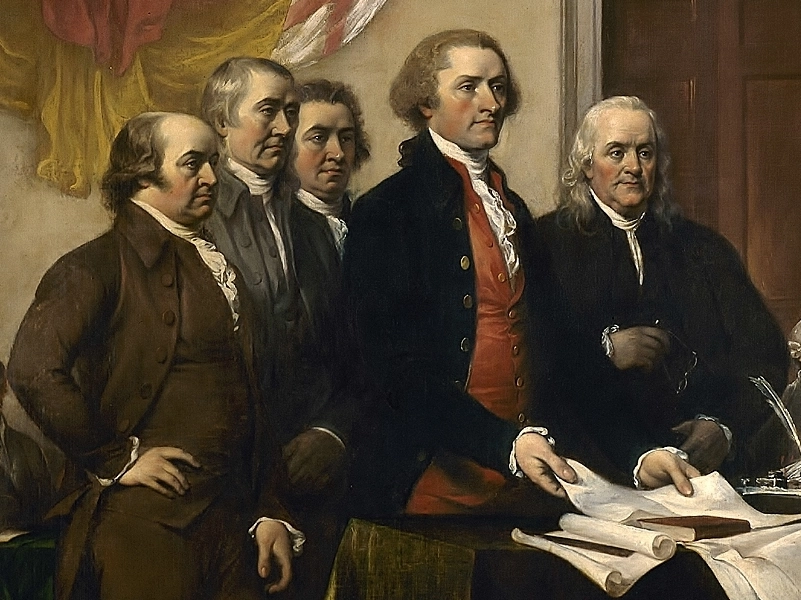
The committee of five included Adams, Franklin, Roger Sherman of Connecticut, Robert R. Livingston of New York, and Thomas Jefferson of Virginia. (Actually, it was only one of many of Congress’s five-man committees.)
Previous committees often handed the job of producing a first draft to John Dickinson. But Dickinson was not chosen for the committee because he wanted to postpone independence. So The Five turned to Jefferson, who was known as an excellent writer.
Thomas Jefferson
Thomas Jefferson (1743–1826) was a polymath—meaning that his talents covered many fields, including law, languages, architecture, farming, natural science, and politics.
He was born into Virginia’s planter class and educated at the College of William and Mary. He studied law under George Wythe, also a leading American Founder.
Jefferson much preferred public service to law practice. He served in the Virginia colonial legislature from 1769 to 1775, when he was elected to Congress. Jefferson was a religious liberal (not a deist, as sometimes claimed, but a Unitarian), and after he returned to the Virginia legislature, he drafted Virginia’s Bill for Establishing Religious Freedom (1777). He served two single-year terms as governor (1779 and 1780), but faced widespread criticism for fleeing before invading British troops.
Jefferson’s only full-length book was the highly successful “Notes on the State of Virginia.” He went on to serve as an American diplomat in France, as the first Secretary of State, as Vice President, and as President of the United States.
Benjamin Franklin
Unlike Jefferson, Benjamin Franklin (1706–1790) was born in very modest circumstances. After two years of formal education, he was apprenticed to his older brother James, a printer. But he ran away, eventually arriving in Philadelphia with one Dutch dollar and about 20 pence in copper.
Yet in the next 25 years, he taught himself to read, write, and translate German, French, Italian, Spanish, and Latin; established a web of successful businesses; organized a fire department and America’s first public library; founded the American Philosophical Society and a militia company; invented the Franklin stove and a new printing method for paper money; served as clerk of the Pennsylvania colonial assembly, postmaster of Philadelphia, and co-postmaster for North America; studied and wrote on whirlwinds and water spouts, and undertook groundbreaking experiments in electricity.
The electricity experiments led to worldwide fame and honorary doctorates from the University of St. Andrews and Oxford.
That was just the first half of his life. Franklin spent the second half in public service: as the most influential member of the Pennsylvania legislature, representative of several American colonies in London, U.S. postmaster-general, president of Pennsylvania, and as a delegate to the Constitutional Convention.
John Adams
It is nearly as exhausting to relate the career of John Adams (1735–1826).
After a successful stint as a Boston lawyer, Adams exploded upon the public scene. He promoted the colonial cause as a writer and member of the First and Second Continental Congresses. With the possible exception of George Washington, he did more to secure America’s independence than any other human being.
Diplomatic tasks kept him in Europe throughout 1778 and early 1779, but when he returned home, the Massachusetts constitutional convention tabbed him as the new state constitution’s primary drafter. Then he traveled back to Europe as a diplomat, where he managed to write an entire encyclopedia of republican governments, the first volume of which was published shortly before the Constitutional Convention and proved influential there and in the ensuing state ratification debates.
Adams was elected Vice President in 1788 and 1792, and President in 1796. As President, he (true to form) made decisions that (1) rendered him deeply unpopular, (2) secured his defeat for re-election, and (3) eventually proved entirely correct.
Roger Sherman
Roger Sherman of Connecticut (1721–1793) was another dynamo—a roaring burst of energy channeled by a fine mind and good judgment.
He was one of seven children of a farmer-cobbler. He became a store owner and a cobbler, and then discovered a talent for mathematics, and thus for astronomy. This induced him to publish an almanac and learn surveying. Surveying opened opportunities for land speculation, at which he was also successful. Not having enough to do, he then became a lawyer.
One measure of the man is that he produced seven children with his first wife and eight with his second. He was 61 years old when he fathered the last.
Like Franklin, Sherman turned over his businesses to others in midlife and entered public service. He was elected to the upper house of the Connecticut legislature (1766–1785), the Continental Congress (1774–1781), and the Confederation Congress (1784). He made very significant contributions at the Constitutional Convention and was elected to the first federal House of Representatives. When he died, he was serving in the U.S. Senate.
Robert R. Livingston
Robert R. Livingston (1746–1813) enjoyed a life quieter than the other members of the Committee of Five—but quiet only by comparison. For 24 years, he was New York’s leading jurist (chancellor). In 1788, along with Alexander Hamilton, he successfully led the pro-Constitution forces at the New York ratifying convention.
In 1801, President Jefferson appointed him minister to France, where he and James Monroe doubled the size of the United States by negotiating the Louisiana Purchase (1803).
After returning to America the following year, he partnered with Robert Fulton in quite another endeavor: They designed and built New York’s first successful steamboat.