




In private enterprise, producing more value for less cost than the competition is what makes a business profitable and successful.
In the world of governments, doing the same is somehow deeply concerning.
Colorado recently ranked #1 overall in education (#9 in Pre K-12 and #3 in higher ed) in a national poll, yet legislators still want to raise taxes by billions of dollars with Proposition NN and Initiative 195 to spend on public schools because, as they claim, they are “underfunded.”
Diminishing Returns
But if Colorado is overperforming in educational achievement relative to spending-per-pupil, the state should be proud, and other states should be trying to replicate Colorado’s success.
Instead, Colorado’s education-industrial complex reaches the opposite conclusion.
Instead of seeing New York City’s $40,000 per-pupil budget as absurdly wasteful, it sees tax dollars not in the hands of the teachers’ unions that other states and cities are squeezing out of their citizenry.
Really, in terms of funding, Colorado has likely long passed into the realm of diminishing returns for education spending.
As explained by Logan McCahill, Colorado school districts that have seen moderate spending increases have improved just as much if not more than districts with large spending increases. Additionally, after COVID, test scores in high-revenue districts have declined as much as low-revenue ones.
This suggests that little correlation currently exists between Colorado’s education spending and academic achievement.
Adding to that, the Common Sense Institute reports that school administration has continued to balloon despite decreasing K-12 enrollment and a stagnating teacher count.
These trends are not symptomatic of a system struggling with funding, but one that actually has too much money and does not know what to do with it besides increasing administrators and their salaries.
What is Underfunded?
According to Colorado Total Program Funding on education from the state’s appropriation reports, and according to school enrollment counts from the Department of Education, Colorado’s funding has continued to grow faster than inflation and school population (see Chart 1).
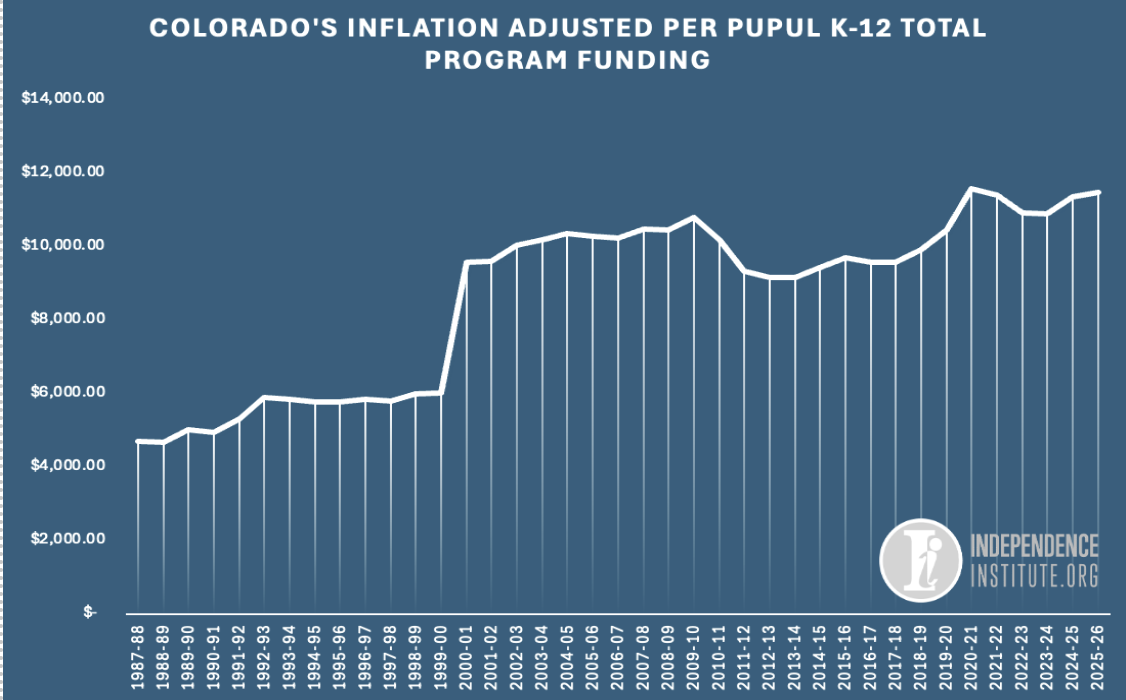
This is incredibly ironic, as it is often the Taxpayer’s Bill of Rights (TABOR) that is blamed for “underfunded” Colorado schools, even though education spending (along with the rest of the state government) has grown beyond the limits of population growth plus inflation.
Colorado is spending almost more than ever, and nearly 2.5 times what the state paid in the 80’s, when adjusting for population and inflation.
However, and conveniently enough for legislators, Proposition NN’s newly retained funds would not count toward the state’s Total Program Funding—which is what studies look at when considering Colorado’s education system as “underfunded.”
In other words, despite potentially billions of dollars more in funding for education, lawmakers and special interests can continue to cry poverty.
Coloradans need to take a step back and look at the bigger picture. The state can be proud of its successes. We already have proof that we can continue to improve things like education while remaining fiscally responsible.
Voters should not give up their constitutional taxpayer protections for the sake of keeping up with the Joneses, especially when the Joneses are New York and California.