


On July 9, 2026, I wrote an article for the Independence Institute breaking down the math behind Colorado’s renewable energy milestone in Q1 2026 and explaining why it is largely driven by the Comanche 3 coal outage, rather than a surge in wind and solar generation.
For Coloradans, it’s worth checking if milestones like these are real, because figures like these are cited as proof that the state can shed its remaining coal and natural gas without consequences for reliability and affordability. The article’s main point, which was supported with EIA generation data, was that Colorado produced less in-state electricity in Q1 2026, and therefore the share of electricity generated by wind and solar looked larger because total generation — the denominator of this fraction — was smaller than before. Had coal-fired generation been running at its prior level, renewables (including wind, solar, and hydropower) would’ve only hit 42.9 percent, not a majority share. Strip out coal outages, and it would have barely budged from the prior year, when renewables actually generated 41.6 percent of Colorado’s in-state electricity.
One critic noted that the piece neglects to mention Comanche 2, whose retirement was postponed by the Colorado Public Utilities Commission (PUC) from the end of 2025 to the end of 2026. Ergo, because one coal-fired plant kept running when another was down on outage, Colorado just swapped one coal unit for another.
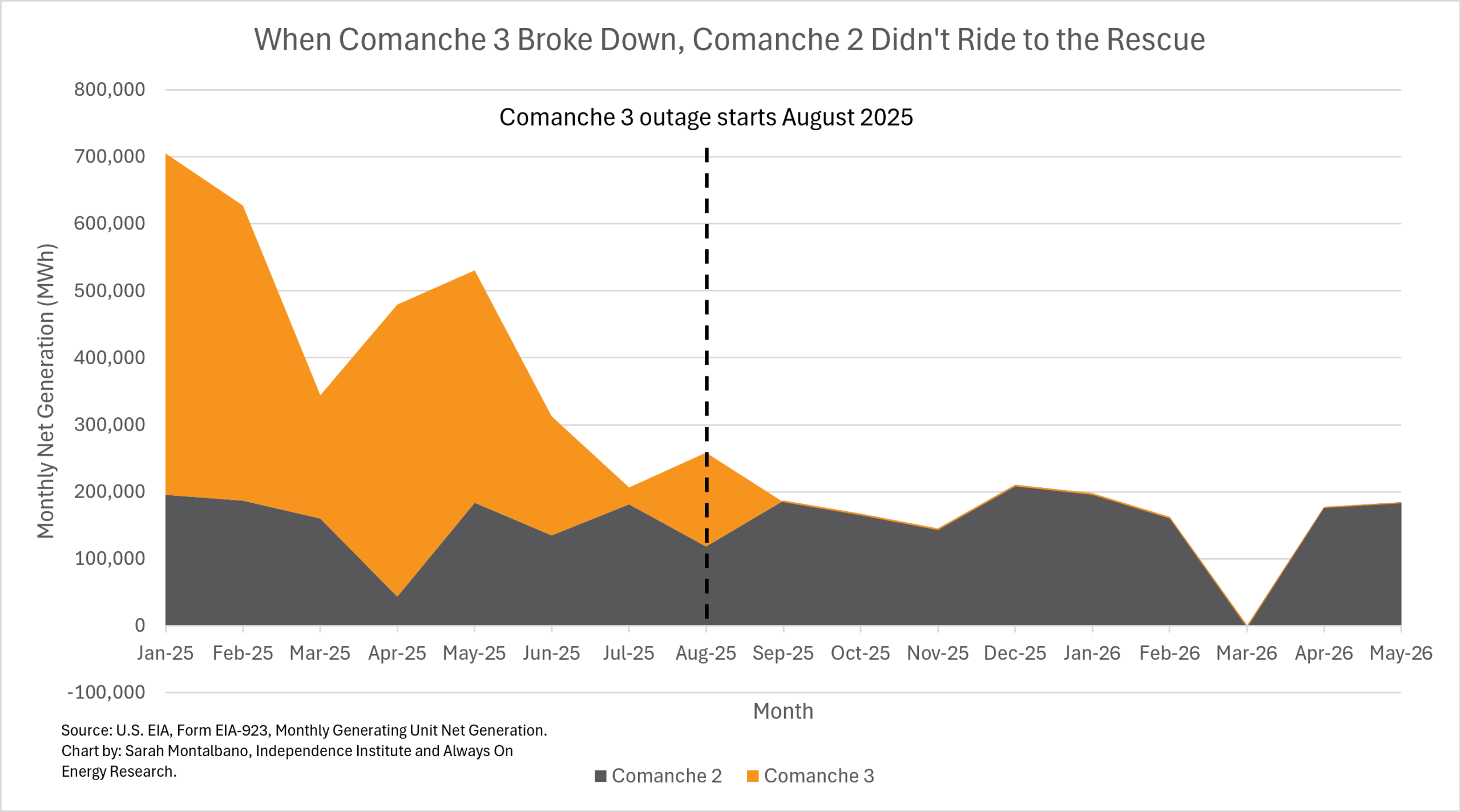
That makes a catchy soundbite, but it doesn’t stand up to either intuition or data. Comanche 2 is already in the 2025 and 2026 baselines because it was generating throughout 2025 and unexpectedly continued running into 2026. As a result, it cannot account for the drop in total generation between them. Furthermore, it could not have been a one-to-one substitution because it is a much smaller power plant. Even in a universe in which Comanche 2 was not online in 2025 but did come online in 2026, Comanche 2’s nameplate capacity, its theoretical maximum output, is only about half that of Comanche 3.
Intuition tells us that Comanche 2 couldn’t have covered the loss, but the math demonstrates that it didn’t even try. Energy Information Administration (EIA) data can split the units at Comanche station into generator-level figures, and it’s telling. Comanche 2’s net generation has remained roughly flat month-to-month from January 2025 to May 2026 — and it briefly dropped to zero in March 2026.
Given that March is a historically low demand “shoulder month,” with higher seasonal renewable output, and the coal unit needed to be ready for a brutal summer, it seems likely Xcel took Unit 2 offline for a maintenance window. Note that Comanche 2’s output also dipped in April 2025 in preparation for the summer, the same shoulder-season pattern it shows most years.
Comanche 2’s Q1 2026 output was 33 percent lower than its Q1 2025 output. Not quite the behavior of a substitute.
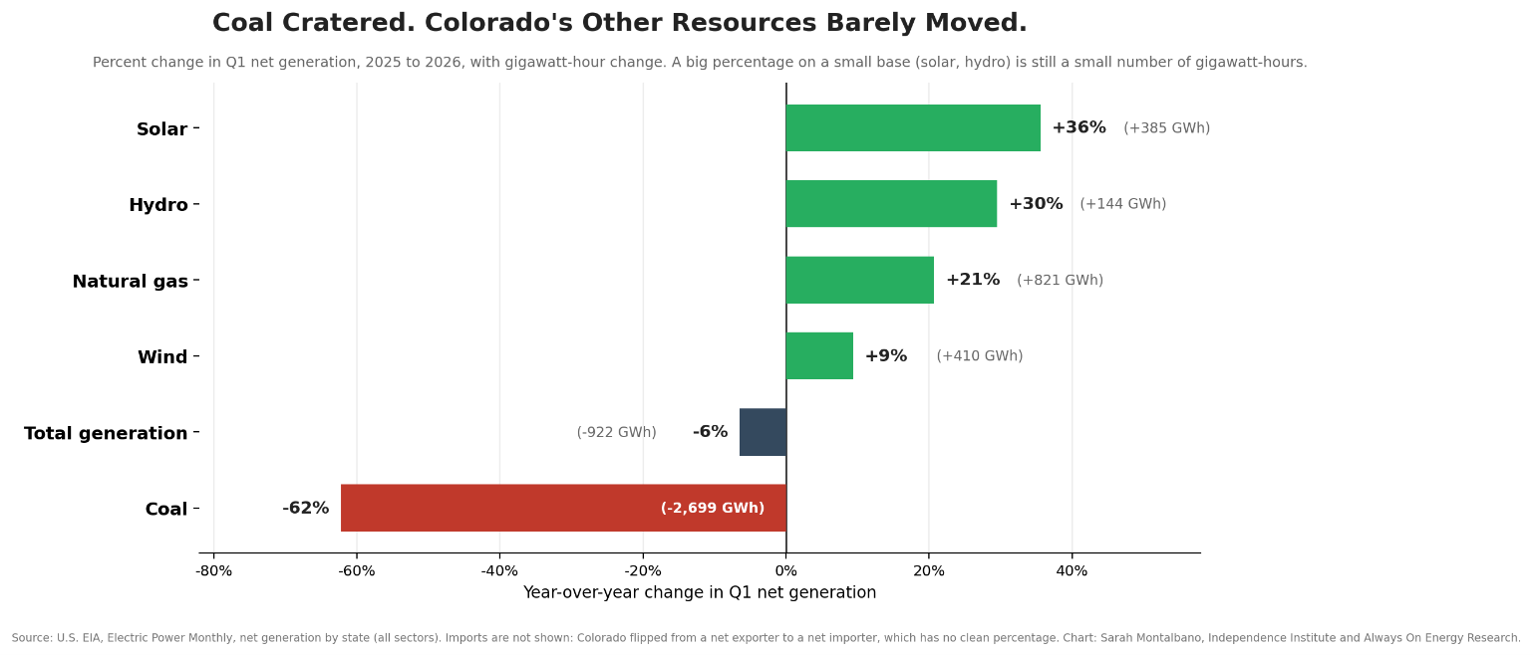
Between Q1 2025 and Q1 2026, coal generation dropped 62 percent and total in-state generation dropped by 6.5 percent year-over-year. About half of the coal decline is attributable to Comanche units 2 and 3, but it seems that Colorado’s coal fleet had an unlucky Q1 2026, which makes the milestone more flattering — and unrepresentative — for wind and solar.
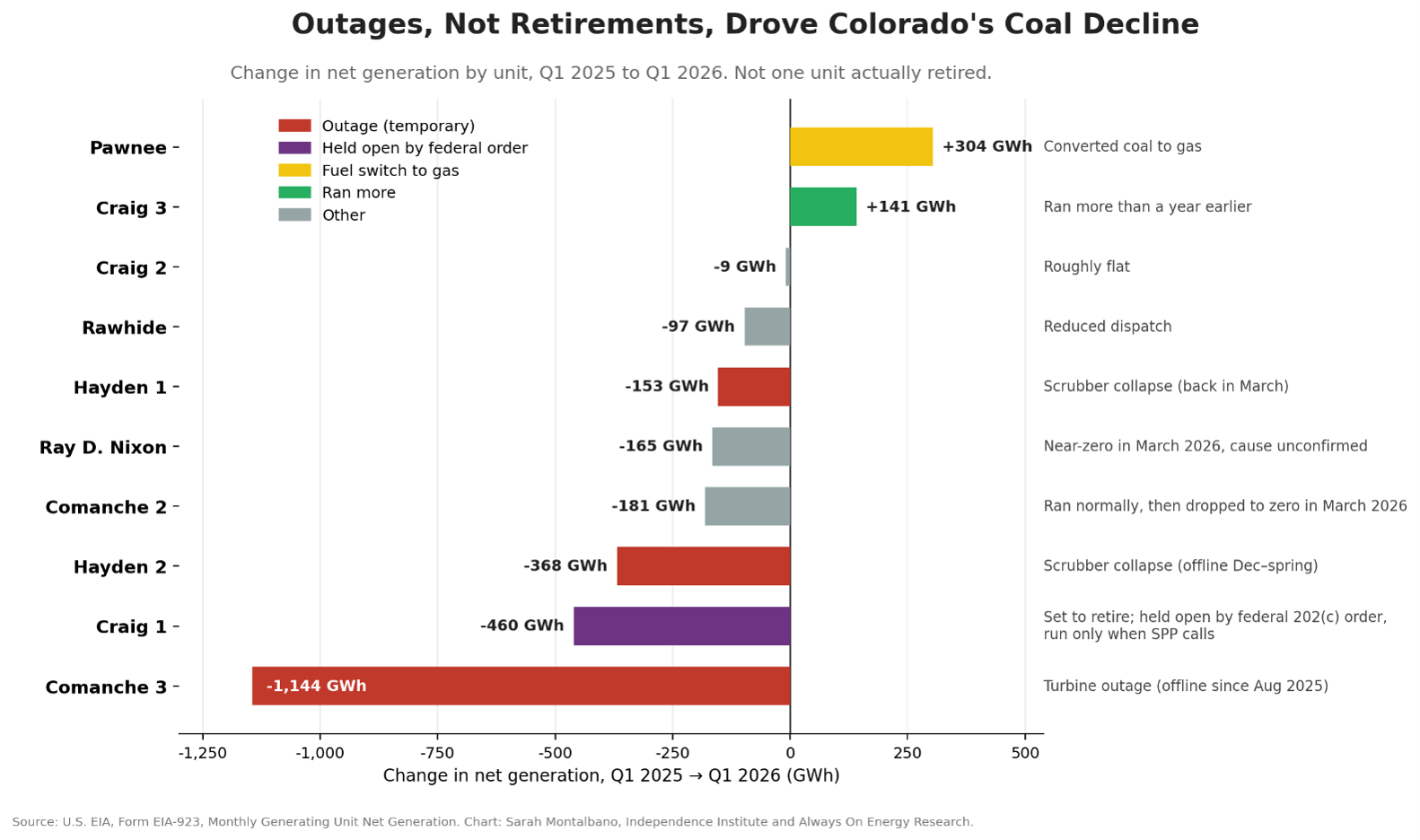
Both units at Hayden went offline for more than a month in late 2025 due to an internal air pollution scrubber vessel collapse. Hayden Unit 1 (190 MW nameplate) only came back in March 2026, and Hayden Unit 2 is scheduled to come back at full strength in August 2026. Pawnee converted to natural gas at the end of 2025, so its capacity is still available as dispatchable capacity, but dropped out of the coal figures in 2026 (and explains much of the increase in natural gas generation). The Ray D. Nixon plant ran near-zero in March, consistent with a maintenance window.
The only coal plant that could’ve dropped out of the denominator permanently was Craig Unit 1, a 446-MW unit, which was scheduled to retire in 2025, and has been made available in 2026 through a federal 202(c) order. However, the unit was only run in 2026 when called upon by the Southwest Power Pool for reliability reasons.
Well over two-thirds of the coal decline between Q1 2025 and Q1 2026 is due to temporary outages, not retirements.
Of the lost coal generation, about 30 percent was backfilled by natural gas, wind and solar about 29 percent, and hydroelectric about 5 percent, with the remainder coming from imports and lower demand. Xcel Energy’s Colorado system flipped from a net exporter to a net importer between Q1 2025 and Q1 2026. They count the wind Colorado exports during gluts and don’t count the power it imports when short. So, the milestone describes the mix Colorado makes, not the mix Coloradans use, and the two drift further apart as imports become a more important backfill.
Coal isn’t an unreliable part of Colorado’s grid. Every thermal plant takes forced outages, and the two that matter most to the math, Comanche 3’s turbine and Hayden’s scrubber, are being repaired and will run again. Wind and solar added generation, but that generation is intermittent, and lowest exactly when summer-peak months like July (re: the close call on the week of July 20, 2026) need dispatchable generation.
This is all aside from the fact that Comanche 2 is likely going to be running for a while, not just as a band-aid while Comanche 3 is on outage. As Independence Institute has reported before, Xcel Energy has asked the PUC to extend Comanche 2 through March 2028. If Xcel Energy chooses to do nothing, the grid will be short of power next summer and next winter, with a 65.5 percent chance of emergency, controlled power outages to prevent widespread blackouts in 2027. The grid should not be operating on such a tight margin, built on intermittent renewables, such that power plants can’t occasionally go offline, whether for scheduled maintenance or repairs.
Comanche 3 is due to come back online later this month, and so is Hayden Unit 2. Once the EIA data can reflect these months, renewables’ share of generation will fall closer to their recent-history norms when coal, and the generation denominator, bounces back. Independence Institute will crunch the numbers again in late 2026.