


The Southwest Power Pool (SPP) issued its highest-level alert on Monday, July 20, 2026, for its western states, including Colorado. SPP’s West balancing authority is back to stable operations at the time of publication, but for a short while on Monday, grid conditions were dicey.
By Monday, July 20, at 4:38 p.m. CT, SPP had put its western region under an EEA Level 1, which is at a “minor risk,” due to “potential low output from wind and other variable energy resources leading into peak hours.” A mere 29 minutes later, SPP had elevated to an EEA Level 3, or “high risk,” only one step below blackouts. By 6 p.m. ET, SPP had dropped its West region to a “moderate risk” and by 6:50 p.m. ET, back to a “minor risk.” By Monday night approaching 10 p.m. ET, conditions reverted to a conservative operations advisory.
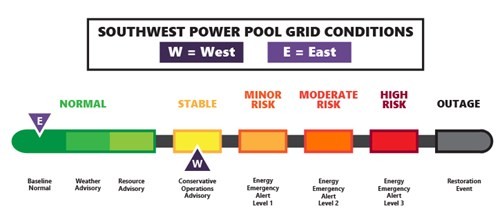
Figure 1: SPP’s grid conditions scale. As of 7/22/2026, the Western Balancing Authority, including Colorado, was back to operating on a conservative operations advisory.
The Platte River Power Authority asked customers in Estes Park, Fort Collins, Longmon, and Loveland to reduce their energy use through 9 p.m. Monday night in response to the advisory (emphasis added):
“Widespread high temperatures, an increase in electric generation resource outages and low production from wind turbines and solar fields across the western footprint… has prompted [SPP] to issue an energy emergency alert in the region.”
Customers were supposed to turn up the thermostat as well as postpone running dishwashers, clothes washers, electric dryers, and other electrical devices because wind and solar did not show up to work.
It’s worth noting that the Platte River Power Authority has been “harangued” by environmentalists and state lawmakers because the company wanted to build five gas-powered turbines to ensure reliability for a grid comprised mostly of intermittent resources. The company’s largest source of energy is the coal-fired Rawhide Unit 1, which the company announced in 2020 will shut down by the end of 2029.
RTO Insider reports that a 250-MW coal plant in the west balancing authority went offline at the same time as solar generation fell and peak demand occurred, though the identity of the plant is unknown.
Craig Unit 1, a 446-MW coal-fired plant under a federal 202(c) order to remain available to the grid, was previously called upon by SPP between July 2 and July 6, 2026, as well as during April energy alert. Odds are good that Craig Unit 1 was called upon during this most recent event to compensate for the loss of the anonymous 250-MW coal plant and disappearing wind and solar.