
The 2025 Regular Session Data
Below are multiple interactive charts that display data collected from Colorado General Assembly fiscal reports from the 2025 regular legislative session. The state legislature is beyond the midpoint of the 120-day regular session, which started in January and ends in May. The data below presents the FTE/fiscal impact of every proposed legislation introduced in the […]
Colorado’s spending joyride on a collision course with reality
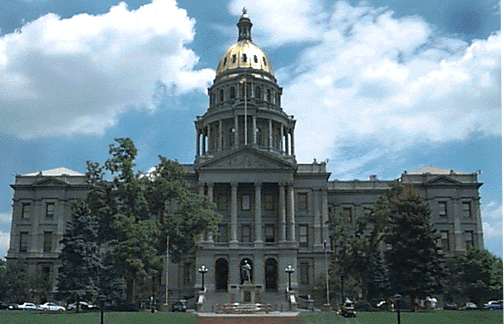
It is well known by now that Colorado’s budget is on an unsustainable path. While there’s considerable disagreement about what is driving the issue and what the solution might be, one thing is for sure: trying to lay blame on the Taxpayer’s Bill of Rights (TABOR) is just pure deflection. As I have written previously, […]
Senate Bill 138: Putting broad-based tax relief ahead of special interests

New legislation has been introduced that is crucial towards creating a more sustainable state budget, as well as putting broad-based income tax relief for Coloradans ahead of special interest loopholes. Senate Bill 25-138, sponsored by Sen. John Carson, a Republican from Douglas County, improves on a similar bill passed last year by first reducing the […]
Colorado Legislature’s Over-Spending Problem Explained

Colorado legislators are discovering first-hand the impossibility of having their cake and eating it too. The Joint Budget Committee continues to meet with dozens of departments to reconcile an approximately $750 million budget shortfall in 2025, with some absurdly claiming that deficit is purely a result of the Taxpayer’s Bill of Rights (TABOR) at work. […]
Course Correction Needed for Colorado’s Economic Outlook

The University of Colorado’s Leeds School of Business recently released their 60th annual Business Outlook for 2025, and, despite a moderate outlook in 2025, the report includes some disturbing trends in the Colorado economy. Let’s take a look at some of what’s going wrong. Troubling trends As pointed out by Denver Post business writer Aldo Svaldi, Colorado was the […]
Counting the Cash Again: An Update on Colorado School Finance

School finance is a constant topic of interest in Colorado education discussions. However, the complex nature of school finance means that many do not feel adequately prepared to meaningfully participate in these conversations. In his latest publication, Senior Education Policy Analyst Ross Izard provides the information needed to have honest, accurate discussions of Colorado’s school finance […]
Citizens’ Budget Panel Event Audio
On Wednesday March 2nd, the Independence Institute held a panel event at the University Club in Denver to discuss the solutions presented in the Citizens’ Budget project. Presenters included project director Penn Pfiffner, Education Center policy analyst Ben DeGrow, Health Care Policy Center director Linda Gorman, and Fiscal Policy Center senior fellow Barry Poulson. Each […]
The Citizens’ Budget
The report provides an overview of the structure, timing and size of the State budget. We speak to how the problems originated and how things have gone wrong in recent years. The Citizens’ Budget includes legislative, constitutional, and policy recommendations to close the looming state budget gap – without raising taxes – and move Colorado […]
How Much Does Government Cost You?
Thanks to our friends at the Independent Institute out in Oakland, California, regular folks like us can figure out just how much the government is costing us in direct payments and in lost earnings over our lifetime. From the About Page on the MyGovCost website, The Government Cost Calculator is a unique service from The […]
A Fiscal Roadmap for Colorado
Colorado appears to be at a crossroads similar to that in California in the late 1980s. At that point California was a dynamic growing economy. That prosperity reflected a fiscal constitution that kept the growth of government in line with the growth of the private economy. California’s GANN Amendment, which was a precursor of the TABOR Amendment in Colorado, limited the growth of state revenue and spending to the sum of inflation and population growth. In the late 1980s, under pressure from the education employee lobby, the California legislature abandoned the GANN Amendment, and the rest is history.
Movie goers in search of an answer to the proverbial concession question: “Would you like a large for a quarter more?”
Reflections on 2007.
Implementing a Just Tax System in Colorado and Strengthening Our Fiscal Constitution
Over much of our history Coloradans have successfully constrained the growth of government through our fiscal constitution. Our State Constitution embodied fiscal rules designed to constrain the power of government to tax and spend, rules requiring a balanced budget, debt limits, and voting and procedural rules. Our fiscal constitution has served us well; our state prospered due in no small part to the fiscal rules embodied in our constitution. However, in the post-WWII period it was clear that our fiscal rules were not constraining the growth of government. Both state and local governments increased taxes and spending grew at rates far in excess of the growth of the private economy. This unconstrained growth of government triggered a tax revolt beginning in the late 1970’s.