


In 2027, Xcel Energy expects that it will miss its reliability standard — the Loss-of-Load-Expectation (LOLE) of only one day in ten years — by a factor of four, even assuming that the Public Utilities Commission (PUC) approves an extension of Comanche 2, a 396-MW nameplate capacity coal-fired unit in Pueblo.
Since June 15, the PUC has been considering Xcel Energy’s request to extend operations of Comanche 2 until March 31, 2028 (proceeding 26A-0235E). In September, Xcel, the PUC staff, the Colorado Energy Office, the Utility Consumer Advocate, and several other parties reached a settlement, and in November, the PUC heard public testimony on the issue. (Western Resource Advocates, the Sierra Club and Natural Resources Defense Council declined to sign but did not oppose it.)
The settlement agreement’s portfolio still leaves Xcel with a 2027 loss-of-load expectation of 0.418 days per year. The plan extends Comanche 2’s lifetime through December 31, 2027, in addition to getting Fort St. Vrain 7 and 8 gas turbines online by October 2027, repairing Hayden Unit 2, extending existing wind and hydro contracts, and signing a short-term gas power purchase agreement. The agreement allows a possible extension to March 2028, only if Xcel seeks the extension and proves “a need for the resource.”
Xcel seems to have made a strong case for it already. Even with these actions, Xcel’s settlement portfolio has a 31.36 percent chance of at least one loss-of-load event in 2027 and a 425 MW shortfall of perfectly reliable capacity. That’s better than the base case (which already includes demand response), which would have a 1.418 LOLE and an 825.3 MW shortfall, but it’s a far cry from the 0.1 LOLE — or one day in ten years — that most utilities shoot for. In fact, none of the seven portfolios that Xcel modeled meet the 0.1 LOLE standard in 2027.
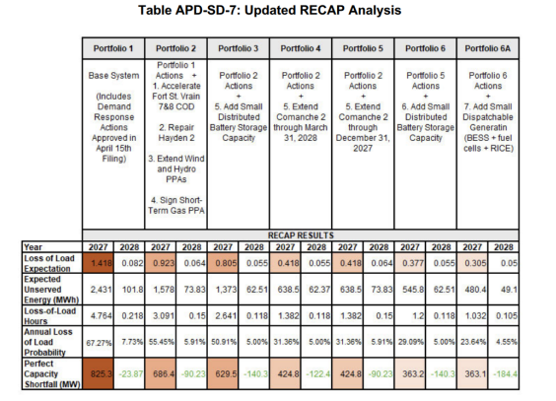
Despite the overwhelming evidence that Xcel will be short in 2027 even with Comanche 2 extended, the November 4 public comment hearing was chock full of arguments about how tightly to cap Comanche Unit 2’s generation under the settlement agreement. Commenters urged using demand response and batteries rather than keeping Comanche 2 running (skim the transcript for their own words on the subject). Were it so easy: The base case, with the 825.3 MW shortfall and 1.418 LOLE, already incorporates demand response actions. Portfolio 6A, not chosen in the settlement, layers distributed batteries, fuel cells, and reciprocating engines (which are usually gas or diesel) on top of the Comanche 2 extension and still misses the LOLE expectation by a factor of three in 2027.
The settlement picked the portfolio with more winter risk than Xcel’s original proposal. Xcel testified that Portfolio 4, with a Comanche 2 extension through March 31, 2028, “successfully eliminates all winter outages in the studied season.” The portfolio in the settlement, which extends Comanche 2 only through December 31, 2027, does not, with modeled outages in January and February 2028.
And to boot, Xcel is mostly counting on one project to get back to a 0.1-or-less LOLE in 2028. Two new gas turbines at Fort St. Vrain are under construction, offering 366 MW of first-year winter accredited capacity (out of 400 MW of nameplate capacity) by January 1, 2028. If the accelerated construction timeline of Fort St. Vrain slips past October 2027, winter reliability will be jeopardized. Xcel is planning to add 524 MW of solar and wind, in nameplate capacity, but in the winter, they can only count on about nine percent, or 45 MW, to help in the winter months.
It is tempting to blame data centers, and several commenters did. Comanche 2 would be necessary regardless of large-load customers, according to Xcel’s testimony: “To be clear, large-load customers are not driving these short-term needs.” The settlement stops Xcel from seeking any extension of Comanche 2 “on the basis of serving new large load customers” and excludes them from the load forecasts used to justify one.
The truth is that Xcel’s reliability issues were baked in well before data centers arrived on the scene, and it (mostly) did it to itself. Retiring Comanche 1 and 2 early, in 2022 and 2025, respectively, was Xcel’s preference, approved in its voluntary Colorado Energy Plan in 2018. The Comanche 2 closure date went into state air rules “with Public Service’s consent and active participation.” The legislature raised the stakes in 2019 by requiring Xcel to cut its carbon emissions 80 percent by 2030.
Xcel’s dispatchable units have seen higher forced outage rates in recent years. Capping output creates more strenuous cycling, and the incentives to delay maintenance are clear: Xcel’s Lauren Gilliland testified that those units with declining availability are “slated for retirement in the near future,” and “the Company has, reasonably, not sought to invest in these units.” The incentives to delay necessary maintenance will only grow stronger when retirement dates keep being pushed back a year at a time, despite needing these units.
And retaining skilled, seasoned staff to operate Comanche 2 will only become more difficult as the retirement timeline becomes more uncertain. When Xcel unveiled its 2021 Clean Energy Plan, it said it would manage the workforce “through attrition, retirements and retraining to assist them in pursuing new roles.” What happens when Comanche 2 is extended perhaps another year, but many of its skilled staffers have retired, retrained, or left the company in anticipation of the plant retiring?
Keeping Comanche 2 running is the cheapest move available for near-term reliability for Xcel. Gilliland pegs the 2027 cost of Comanche 2 under the settlement at $32.4 million in capital and fixed operating costs, plus $24.9 million in fuel and variable costs, and another $796,320 on top for annual “air quality fees,” (part of which is run through an “enterprise” to get around TABOR) as required by SB 20-204. Running at the settlement’s output cap of 63 percent capacity factor, fixed costs work out at about $18 per megawatt-hour (MWh), and the plant’s recent fuel costs run about $21 per MWh. Running Comanche 2 through March 2028 rather than stopping at December 2027 adds less than $100,000 over two years and eliminates modeled winter outages.
The alternative is buying power on the market, and the regional market has not been able to deliver thus far. Winter Storm Fern sent prices spiking in January 2026, and SPP West suffered an Energy Emergency Alert (EEA) Level 3, one step below rotating outages, on July 20, 2026. SPP West has no resource adequacy requirements until June 1, 2027, and market participants have contributed far less to the market than SPP expected, at only 4.7 GW from April through August out of 9.2 GW of nameplate capacity — far less than the 6.5 GW that SPP expected.
The PUC should approve the Comanche 2 settlement agreement and decide now whether to keep it running through March 2028, or beyond. The first thing to do when one is in a reliability hole is to stop digging, and maintaining and running existing units is the quickest and most affordable way to do so.