

As we continue to digest the latest reports from the Colorado State Demography Summit, no revelation is more profound than the impacts of the state’s rapidly-declining fertility rate on the school system and the state’s future workforce. Some of the state’s largest school districts could lose 30 percent of their population within a decade. Communities will mourn the loss of schools and jobs, businesses will struggle to find home-grown workers, and taxpayers will begin asking serious questions about automatically-increasing school district budgets.
Falling fertility rates
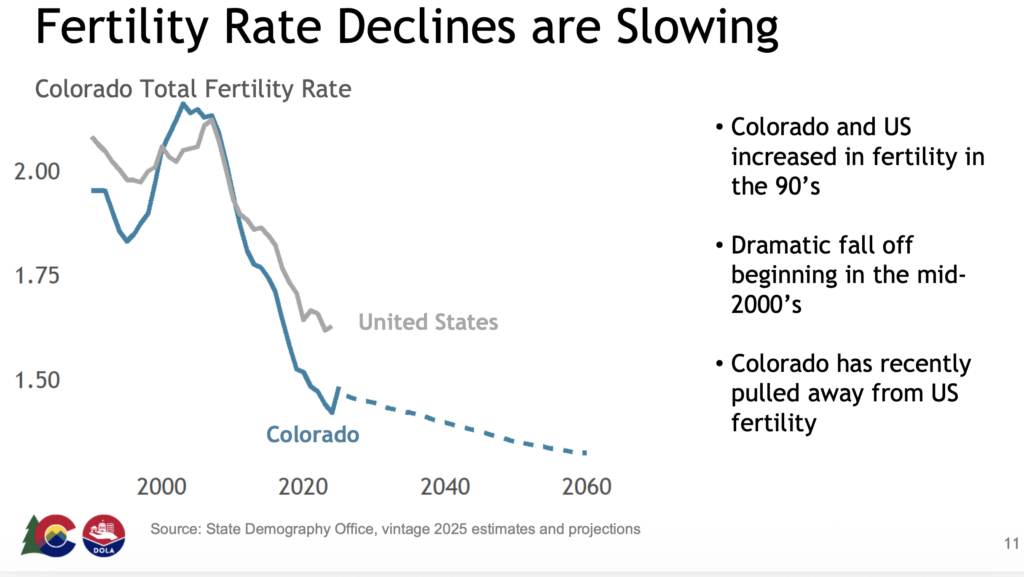
Colorado’s fertility rate is around 1.5 today, far below the “replacement rate” of 2.1, but is expected to drop further in the years to come.
The problem is not unique to Colorado, but Colorado’s rates are lower than the national average, and falling faster. This article will not dwell upon the many reasons why the phenomenon is occurring, but CDSO noted that in addition to global and national factors, Colorado’s high cost of living drives more parents to to wait years longer before trying to conceive, for both parents to choose work over staying home, and associated child care considerations influence decisions to have fewer kids.
In-migration no longer cushions the losses.
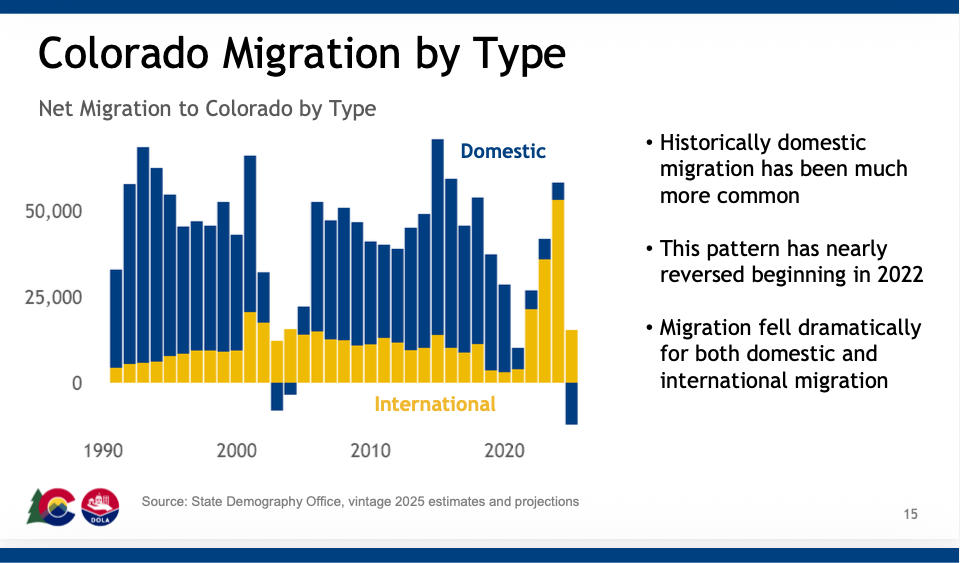
Colorado also loses students to out-migration, a term that measures the total people leaving the state against new transplants from within the United States. Last year, Colorado netted a loss of 12,600 residents to out migration. Not coincidentally, the state also lost nearly 5,000 total jobs. Record levels of international immigration blunted the impact to some school districts during the Biden Administration, but changing administrations and international conditions brought the influx to a halt, with at least two more years of minimal immigration on the horizon.
The CDSO notes that the Biden-era immigration influx is not likely to be repeated even if national immigration policies change, and an increase in immigrants may not deliver as many school-age kids to the state as in the recent past. According to shocking new global studies, birth rates are falling faster in developing countries than in the United States. Mexico’s 2025 estimated fertility of rate of 1.2 is lower than Colorado’s rate of 1.5.
Enrollment declines hit unevenly.
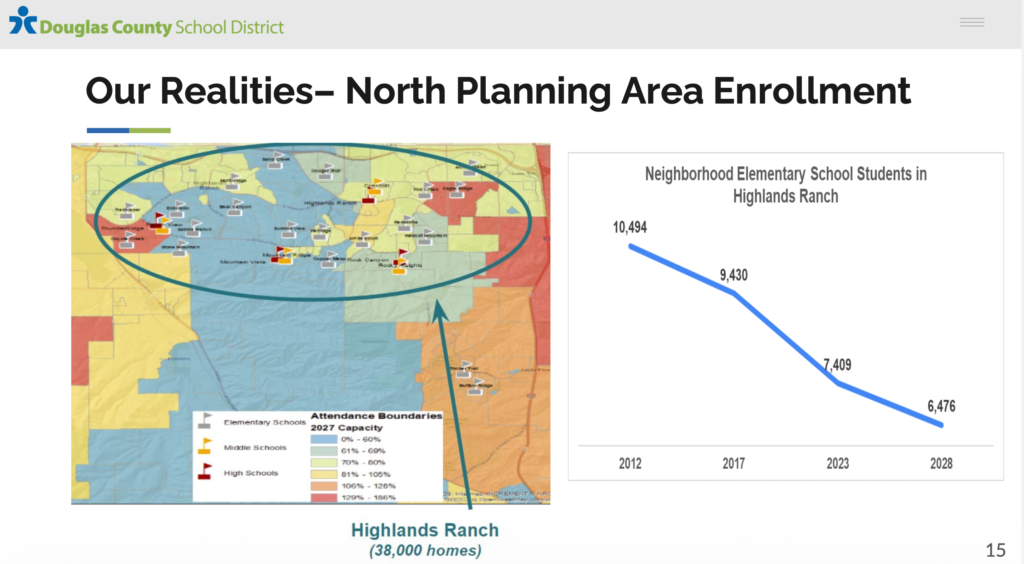
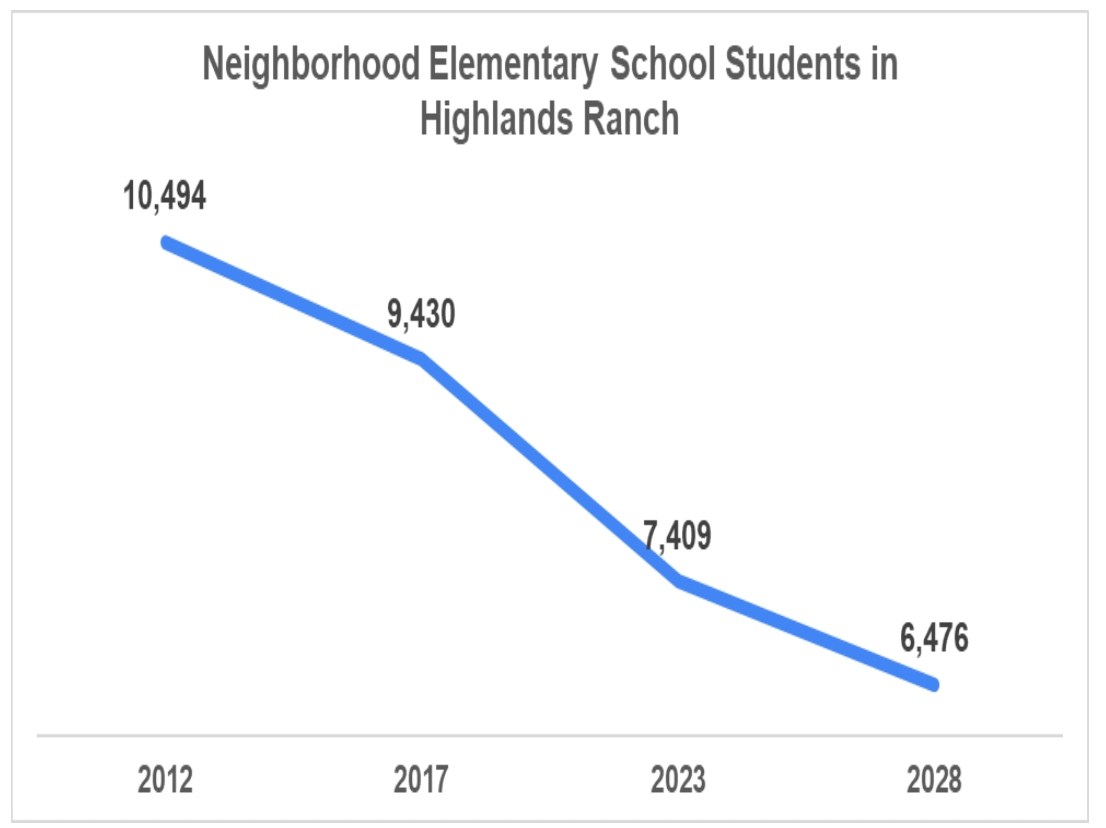
At CDSO’s Summit, Douglas County School District presented on the challenges of maintaining school populations in areas like Highlands Ranch, where housing prices are out of reach for young families, and where older Coloradans remain in their homes long after their kids graduate and move away. Neighborhood elementary schools in Highlands Ranch experienced rapid declines (see the blue areas in the chart above, where some schools are at 60% capacity), while nearby charter schools held steady. Schools near new housing developments like Sterling Ranch saw increasing enrollment. 40% of Dougco students leverage choice-enrollment to pick their school and are not as likely to be directly impacted by neighborhood school closures. During the last Jefferson County School District round of School closures, northern Jeffco neighborhood school enrollment fell at twice the rate of the district’s average, but nearby charter school enrollment held steady or slightly increased.
Takeaways: What should community and district leaders do differently?
That is the question we will explore in depth over the coming months. But for now, the data points towards the following:
- Housing supply drives future enrollment. If a community wants to sustain a school, it needs to make space for new families.
- School choice helps to mitigate the impact and clarify the direction for school closures. Choice-friendly districts like Dougco or Denver Public Schools will likely still experience declining enrollment, even in charter schools- but closure decisions become demand-based evaluations, rather than demographic-based.
- High income, sales and property taxes increase the cost of living and drive more young families away.
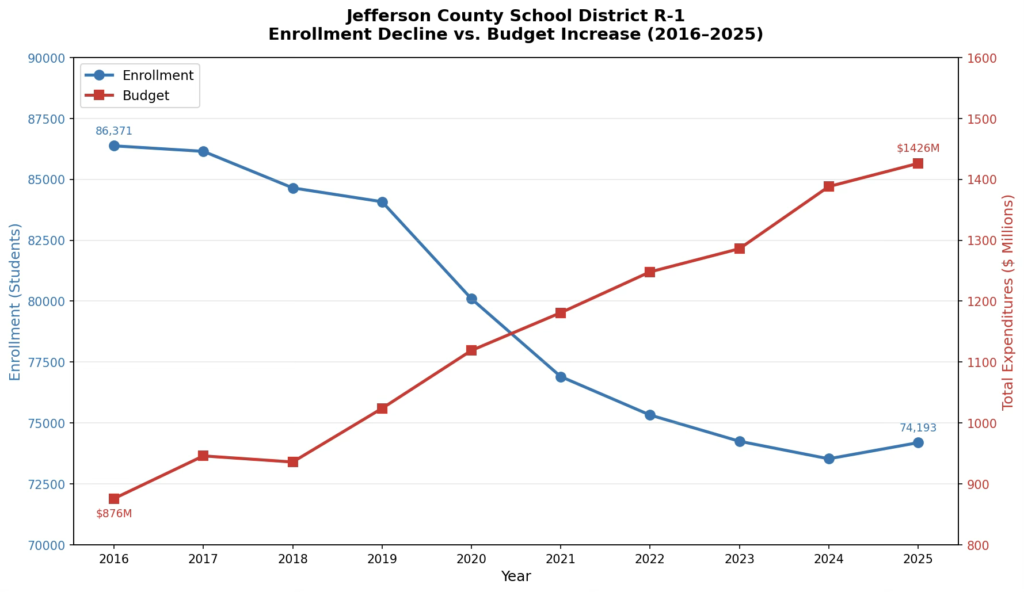
- At some point, district taxpayers will begin asking obvious questions about the disparate trajectories of school district budgets and school district enrollment. (Example: Jeffco’s 2016-2025 budget vs. enrollment, below).