
Ownership of Federal Land: Answers Suggested by the Bundy Standoff
The Bundy stand-off in Nevada has induced several people to ask me about the extent to which the federal government can own land, at least under the Constitution’s intended meaning. As it happens, in 2005 I studied the issue in depth, and published the following article: Federal Land Retention and the Constitution’s Property Clause: The […]
The American Founders: Latin Lovers
Take out a dollar bill and look on the back. There you will see the two sides of the Great Seal of the United States. Look at the left hand side—the circle with the pyramid. Above the pyramid is a representation of the Eye of Providence—of God. Above the eye is the phrase, Annuit coeptis. […]
Sources for Understanding the Constitution's Original Force
Would you like to examine some of the documents we use to better understand the original Constitution? Several years ago, I wrote the first Internet essay on how to find the sources vital to interpreting the Constitution as the Founders intended it to be. I have just updated that essay. It is called A Bibliography […]
Sources for Understanding the Constitution’s Original Force
Would you like to examine some of the documents we use to better understand the original Constitution? Several years ago, I wrote the first Internet essay on how to find the sources vital to interpreting the Constitution as the Founders intended it to be. I have just updated that essay. It is called A Bibliography […]
Justice Thomas, Quoting Rob Natelson, Had the Constitution Correct In the Arizona Citizenship-for-Voting Case
NOTE: This is the first of several short commentaries on recent Supreme Court decisions. The Supreme Court recently ruled that Arizona’s law requiring proof of citizenship for voting violates federal statutes. In his dissent, Justice Thomas relied heavily on my own research. The Independence Institute did not participate in that case. So how did it […]
Constitutional Arcana: The Forgotten Navigation Convention of 1786
In an earlier post, I reported that the Constitutional Convention of 1787 was far from unique: that during the lifetime of Benjamin Franklin (1706-1790) nearly 20 inter-colonial and interstate conventions met. Some were attended by as few as three colonies or states; others by as many as 12. These multi-governmental conventions were held in Philadelphia […]
The Constitution’s officers
Proceeding on the very reasonable theory that the Founders knew what they were doing . . . Seth Barrett Tillman has spent considerable effort reconstructing the meanings of different office/officer phrases.
Did the Founders expect the Courts to Declare Laws Unconstitutional?
Every so often I’m asked whether the Founders anticipated judicial review. In other words, whether the Founders expected the courts to void laws they found unconstitutional. The clear answer is “yes.” During the colonial era, each colony was governed by its charter, which was a kind of constitution for the colony. Colonial laws in violation […]
The Great Forgetting
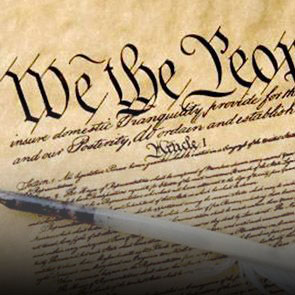
The meaning of some of the Constitution’s 18th century terminology was lost during the 19th century, leading to widespread misunderstanding.
The greatly misunderstood Chief Justice John Marshall
One of the most enduring myths in American constitutional history is that Chief Justice John Marshall was a judicial activist whose decisions are good precedent for the modern federal monster state. Marshall was the fourth chief justice of the U.S. Supreme Court (third, if you don’t count John Rutledge, a recess appointment who was never […]
The 1798 “Act for the Relief of Sick and Disabled Seamen:” Yet another “progessive” irrelevancy
As Tom Woods points out on his blog, advocates of Obamacare have dug up a 1798 federal statute that, they say, shows that the original understanding of the Constitution is broad enough to authorize federal health care programs. The statute authorized creation of federal hospitals for sailors. After I entered a brief response to his […]
Is health insurance “Commerce among the States?”
Behind the current constitutional debates over ObamaCare, there is an assumption that Congress has power to regulate health insurance as “Commerce among the States.” However, in various decisions over 150 years, the Supreme Court ruled that “insurance” was not within the Constitution’s definition of “Commerce.” Only a single aberrant Supreme Court case says it is. […]
