
Rob Natelson Cited Again at Supreme Court—This Time in a Religion Case
I’m pleased to report that this past week the brilliant Justice Clarence Thomas cited my work on the Necessary and Proper Clause in his concurring opinion in Town of Greece v. Galloway, an Establishment Clause case that received wide publicity. This was the thirteenth citation in the third Supreme Court case in the past 11 […]
Get Members of Congress Out of the Business of Rigging Campaign Rules
The Supreme Court’s latest campaign finance decision, McCutcheon v. FEC, has sent up the predictable howls. In McCutcheon, the Court struck down, as violating the First Amendment, certain incumbent-protection rules that Members of Congress had rigged for their own election campaigns. But no one—including the Court—has yet convincingly addressed a question even more fundamental than […]
How Do We Know an Article V Amendments Convention is a “Convention of the States?” Because Both the Founders and the Supreme Court Said So
Article V of the Constitution authorizes a “Convention for proposing Amendments.” However, it does did not specify how the convention is to be composed. People unfamiliar with constitutional history sometimes claim the makeup of an amendments convention is either a complete mystery or subject to the determination of Congress. Nonsense. For one thing, the Supreme […]
The American Founders: Latin Lovers
Take out a dollar bill and look on the back. There you will see the two sides of the Great Seal of the United States. Look at the left hand side—the circle with the pyramid. Above the pyramid is a representation of the Eye of Providence—of God. Above the eye is the phrase, Annuit coeptis. […]
Sources for Understanding the Constitution’s Original Force
Would you like to examine some of the documents we use to better understand the original Constitution? Several years ago, I wrote the first Internet essay on how to find the sources vital to interpreting the Constitution as the Founders intended it to be. I have just updated that essay. It is called A Bibliography […]
Sources for Understanding the Constitution's Original Force
Would you like to examine some of the documents we use to better understand the original Constitution? Several years ago, I wrote the first Internet essay on how to find the sources vital to interpreting the Constitution as the Founders intended it to be. I have just updated that essay. It is called A Bibliography […]
Get Rob's authoritative book on the Constitution's REAL meaning
The Original Constitution: What It Actually Said and Meant (2nd ed.) is an objective explanation of the Constitution as understood immediately after adoption of the Bill of Rights. The Original Constitution is written for the layperson. It draws on legal and historical sources alike, including many long-overlooked by other writers. Get it here or here.
A Response to Professor Seidman
Should we acknowledge that the U.S. Constitution is filled with “archaic, idiosyncratic and downright evil provisions,” and “extricat[e] ourselves from constitutional bondage” by cashiering the document? “As the nation teeters at the edge of fiscal chaos, observers are reaching the conclusion that the American system of government is broken,” argues Louis Michael Seidman, tasked with […]
Constitutional Arcana: The Forgotten Navigation Convention of 1786
In an earlier post, I reported that the Constitutional Convention of 1787 was far from unique: that during the lifetime of Benjamin Franklin (1706-1790) nearly 20 inter-colonial and interstate conventions met. Some were attended by as few as three colonies or states; others by as many as 12. These multi-governmental conventions were held in Philadelphia […]
The Constitution’s officers
Proceeding on the very reasonable theory that the Founders knew what they were doing . . . Seth Barrett Tillman has spent considerable effort reconstructing the meanings of different office/officer phrases.
Did the Founders expect the Courts to Declare Laws Unconstitutional?
Every so often I’m asked whether the Founders anticipated judicial review. In other words, whether the Founders expected the courts to void laws they found unconstitutional. The clear answer is “yes.” During the colonial era, each colony was governed by its charter, which was a kind of constitution for the colony. Colonial laws in violation […]
The Great Forgetting
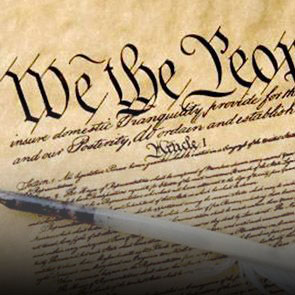
The meaning of some of the Constitution’s 18th century terminology was lost during the 19th century, leading to widespread misunderstanding.
