
The Define and Punish Clause doesn’t authorize vast federal power either

Legal commentators have spread a good deal of ink trying to show that the Constitution authorizes the enormous expansion of the federal government since the 1930s. Leading the way have been some associated—as professors, students, or alumni—with the most privileged educational institutions: Harvard, Yale, Chicago, and so forth. Their publications inflated the Commerce Clause to […]
The Convention of States in American History
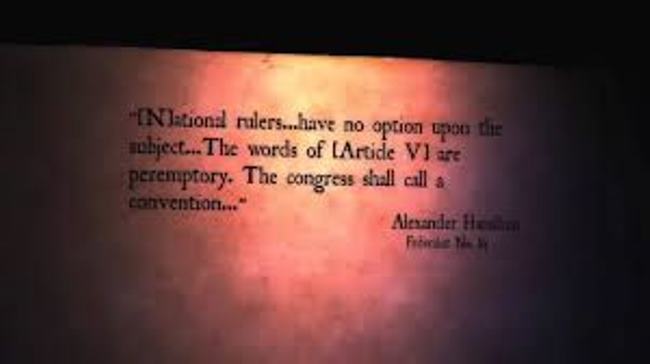
In this short essay, constitutional historian Rob Natelson thumbnails the three-centuries long history of “conventions of the states.” When delegations from the states assemble in Phoenix, Arizona later this year, they will be basking in a long and rich American tradition. As far back as 1677, British colonies in North America sent “commissioners” (delegates) to […]
Where Congress’s Power to Regulate Immigration Comes From
Congress’s power to regulate immigration comes from the law of nations—the meaning of which many constitutional commentators are unfamiliar.
The Relationship Between the Declaration of Independence and the Constitution
I’m sometimes asked about the relationship between the Declaration of Independence and the Constitution. Their connection is not difficult to understand. The Declaration is a statement based on natural law. Natural law consists of fundamental principles of justice and right. Monotheists see natural law as deriving from the Creator. Polytheists see it as deriving from […]
A New Look at the Founders Through the Postal Clause

The Constitution’s Postal Clause grants Congress power to “establish Post Offices and Post Roads.” There is a fascinating history behind that provision, which I explore in a new article linked here. Some of the highlights: * Although the Founders generally favored free enterprise over state-owned business, they made an exception for postal services. * As […]
Yes, Mr. President—You Must Enforce Laws You Don’t Like
Must the president enforce laws he doesn’t like? The answer to this question lies in the Constitution’s phrase that the president “take Care that the Laws be faithfully executed.”
Did Congress Approve the Constitution? A Member’s Letter Says “Yes”
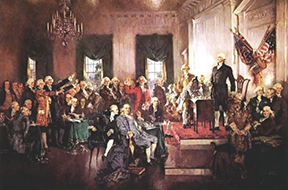
Some people argue the Constitution was adopted illegally. They assert that the Confederation Congress needed to approve the document, but never did. But principles of law tell us that they are wrong. So does a rarely-mentioned letter from a member of the Confederation Congress. It is true that most (not all) of the resolutions by […]
This Resolution Suggests Congress Did Agree to a Broad Constitutional Convention
On April 23, 1787, the Confederation Congress extended the post office franking privilege to all commissioners about to attend the Constitutional Convention. In other words, Congress gave to convention delegates the same privilege to send and receive free mail its own members enjoyed. Why is that important? Because it tends to show that Congress accepted […]
Changed Conditions May Justify Term Limits
This is the full version of an op-ed first appearing in the Detroit Daily News. Advocates for term limits want to amend the Constitution to add them. Their most common argument is that restricting how long an elected official may serve will curb special interest influence and other federal abuse. The Articles of Confederation, the document […]
What Connecticut’s Authorizing Documents Tell Us About the Constitutional Convention—and About Modern Misinterpretations
On May 11, 1787, the Samuel Huntington, the governor of Connecticut, addressed his state legislature about the pending Constitutional Convention. Shortly thereafter the legislature adopted a law governing Connecticut’s participation in the gathering—the eleventh state to do so. (Only Maryland acted later.) The governor’s remarks, and the ensuing legislative resolution, illustrate the following: * The […]
Could Congress Control an Amendments Convention? Not According to the Founders!
As we move closer to holding a “convention for proposing amendments” to restrain federal overreach, naysayers have not been silent. One of their claims is an amendments convention would be fruitless or dangerous because it could be controlled by Congress. The Constitution directs Congress to “call” an amendments convention when two thirds of the state […]
Originalist Research Guide Updated
Scholarly investigation into our Constitution’s actual meaning—or, more precisely, into the Constitution’s legal force immediately after adoption—commonly is called “originalist” research. Until fairly recently, the quality of originalist research was fairly low. Most of it was conducted by law professors with little background in historical method or in founding-era language or social conditions. Moreover, most […]
