



Last night, several Colorado-based utilities officially joined the Southwest Power Pool, a regional transmission organization serving members in all or part of 17 states. Colorado Springs Utilities, Platte River Power Authority, Tri-State Generation and Transmission, and others have become part of the RTO, which is the first “to bridge the eastern and western electric grids.”
These utilities serve hundreds of thousands of Coloradans, and their entry into an organized wholesale market will matter for ratepayers in their service territories. A 2021 Colorado law requires non-municipal utilities with transmission assets to join an organized wholesale market by 2030, so this was not purely a market-driven decision. But there are reasons why it’s happening now.
An RTO coordinates wholesale electricity dispatch across a large region, matching buyers and sellers to find the lowest-cost available power. Unlike vertically integrated utilities, which own power plants and transmission assets, and recover costs through regulated rates, an RTO owns no infrastructure and does not set retail rates.
For Colorado’s public power utilities, this is an appealing way to source more generation as state policies push dispatchable power offline. Colorado Springs Utilities CEO Travas Deal has said that the RTO “offers unprecedented access to regional transmission and generation resources that will… manage customer costs and ensure the reliability of our electric grid.”
Springs Utilities has claimed to save customers $4.7 million in its first year of participation in SPP’s energy imbalance market since 2022. Full RTO membership expands that access across SPP’s now-17 state footprint. A 2021 PUC study estimated $230 million in annual savings from RTO participation, but that assumed full participation by all Colorado utilities, including Xcel Energy, which is not joining SPP in full, but only its day-ahead Markets+ offering.
Unfortunately, there are only four small transmission ties connecting SPP’s service territory with Colorado in the Western Interconnection. This will act as a physical constraint on how much power Colorado can exchange with the SPP grid. Building more transmission will cost ratepayers, and Deal has acknowledged that limited transmission capacity “is also adding significant cost to delivering power from these projects to our local electric grid.”
One benefit of RTOs that Colorado’s political establishment will love is what membership does for emissions accounting. United Power CEO Mark Gabriel said in January that joining SPP will “expand access to more renewables needed to meet Colorado’s clean energy requirements.” When a Colorado utility buys wind power generated in Kansas through the SPP market, that power counts toward Colorado’s emissions reduction targets. In practice, the electrons flowing through Colorado’s grid may not change much.
Colorado has set aggressive decarbonization targets. HB 19-1261 set economy-wide emissions reduction targets and both SB19-236 and SB 23-016 require the state’s largest utilities to achieve 80 percent power-sector emissions reductions by 2030 and 100 percent by 2050. RTOs give states a way to claim credit for wind and solar energy produced hundreds of miles away without doing the hard, expensive work of building that generation and transmission capacity in-state.
We have seen this dynamic play out in PJM, where states with ambitious clean energy mandates rely on a broader grid that still depends on coal and gas generation in Ohio, Pennsylvania, and West Virginia. Those states keep the lights on for the region; the mandate-heavy states get to take credit for green energy and, in the process, drive up capacity costs for everybody. PJM states are now openly feuding with the RTO over governance and costs. Its most recent capacity auction saw costs explode from $2.2 billion to $16.1 billion.
PJM’s reliable, always-available capacity has declined since 2013 even as total installed capacity grows, because solar panels and batteries cannot deliver power as dependably as the coal and gas plants they replace.
As J.P. Morgan’s Michael Cembalest observed in his March 2026 energy paper, “some utilities within PJM are questioning whether re-regulation would be the better option (Exelon, First Energy, PPL, and PSEG); I agree with them.” Colorado is entering an RTO model at the very moment that utilities within the country’s largest and oldest RTO are considering other paths. SPP’s other member states, which maintain the dispatchable generation that keeps the grid running, may tire of subsidizing Colorado’s mandates.
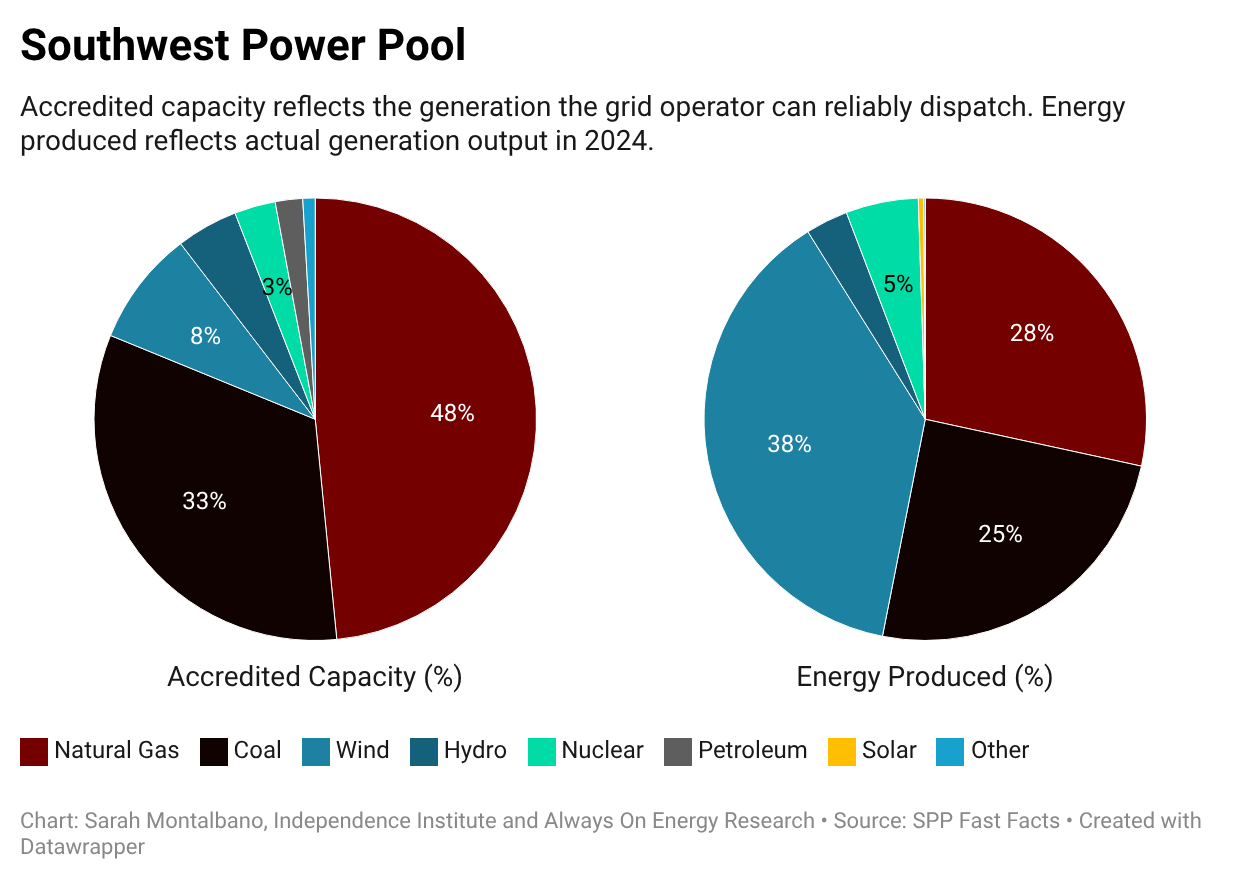
Colorado’s utilities also shouldn’t count on SPP to be a reliability lifeline. NERC’s January 2026 Long-Term Reliability Assessment found that SPP faces falling reserve margins as demand outpaces new generation, and that the risk grows worse when the wind dies down and plants trip offline unexpectedly. SPP’s grid is dominated by wind energy and natural gas, so joining hands with Colorado utilities simply shares the reliability risks among more utilities.
Colorado’s entry into SPP is not necessarily a bad thing, but membership won’t be a silver bullet for reliability or affordability. Colorado would need massive transmission investment before it can fully benefit, and much of that need is driven by the state’s insistence on replacing reliable, dispatchable generation with intermittent sources that require long-distance delivery from other regions. A state that kept its baseload plants running would not need to import nearly as much power from Kansas and Oklahoma and would not need to fudge its decarbonization numbers to hide the trade-offs from voters.
As with most policies, there are tradeoffs to everything.
