


This month, Public Service Company of Colorado, Xcel Energy’s subsidiary in Colorado, reached a proposed settlement in its rate case filed in November. In a separate filing this week, the company admits that it cannot keep the lights on consistently through 2027 without running the coal plants it has advocated to close.
The settlement deal would lower Xcel’s original request about 37%, from $356 million to $224.9 million, raising the average residential bill 5.85 percent, or $6.13 per month, beginning in August 2026. PUC staff, the International Brotherhood of Electric Workers (IBEW) union, and the state’s large industrial customers, including Walmart and Climax Molybdenum, signed on to the deal.
According to reporting from the Colorado Sun, the settlement trims what Xcel proposed to earn on its new capital investments. Its return on equity — what Xcel makes on its rate base, which grows as the company builds new assets — will be reduced to 9.3% from the proposed 9.8%. According to the Sun, despite not filing rate increases since 2023, Xcel has added riders, which are separate line-items on customer bills, that have raised rates 22 percent over three years.
Despite charging more, Xcel Energy is delivering less and risking reliability problems from its retirements of dispatchable generation. Nothing makes this clearer than a new proceeding filed June 15 at the PUC examining 2027-2028 Resource Adequacy (26A-0235E). In testimony from Xcel Energy’s Regional Vice President of Integrated System Planning, Zeryai Hagos, Xcel projects the system will be short 527 megawatts in summer 2027 and 388 megawatts the following winter. That’s assuming that Xcel Energy will be able to reduce demand through demand response measures and that Comanche Unit 3 returns to service in August 2026.
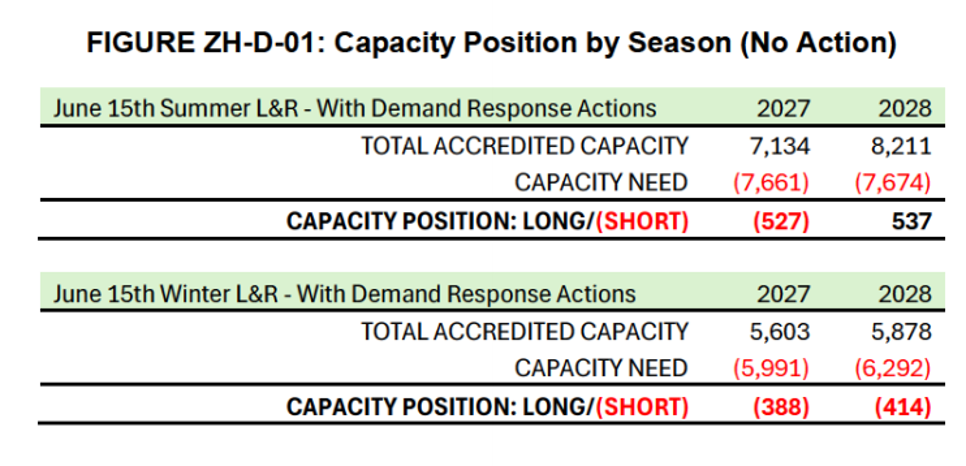
Hagos testifies that “if no actions are taken to address the shortfall, the probability of loss of load event would be nearly 14 times greater than” the reliability target. Utilities aim for a loss-of-load expectation of 0.1 days per year, or one day in ten years, meaning that customers aren’t supposed to face an involuntary outage more than once per decade. Xcel’s no-action expectation is 1.39 days per year. Xcel’s do-nothing case carries a 65.5 percent chance of a load-shed event — an emergency, controlled power outage to prevent widespread blackouts — in 2027.
Xcel’s preferred fix extends the Comanche 2 coal unit through March 2028 and leans on natural gas, accelerating the construction of two 200-megawatt gas turbines at Fort St. Vrain and adding gas under contract. Despite keeping this coal online, the reliability target still sits nearly 5 times the target rate, but the portfolios that skip the coal extension in favor of other options leave the 2027 reliability risk nine to ten times the target.
Repairing Comanche 3 and keeping Comanche 2 available is the only responsible near-term call. In fact, “The Company is not comfortable operationally with any of the portfolios that do not extend Comanche Unit 2” due to the severe reliability risks. “To be clear, large-load customers are not driving these short-term needs,” said Xcel’s Michael V. Pascucci, the company’s regional vice president for planning and policy.
Unfortunately, these closures are a mess of Xcel’s own making. Comanche 2, a 335-megawatt unit built in 1975 and originally scheduled to run through 2035, was pulled to a 2025 retirement under Xcel’s voluntary 2016 clean energy plan, which the PUC approved in 2018. That decision came before Xcel lobbied the state to establish Colorado’s economy-wide greenhouse gas reduction laws in 2019, not after.
The commission should approve the Comanche extension and the gas additions, because the cost of refusing them is Coloradans suffering under blackouts caused by short-sightedness. What the PUC should not uncritically accept is the story comes with the rate case. A utility that has volunteered to close its coal plants and billed customers to build the intermittent wind and solar replacements, is now billing them again because it is unprepared for new demand.
The documents in Xcel Energy’s rate case can be found under proceeding number 25AL-0494E using the Search function of the PUC’s e-filings system. The details of the 2027-2028 Resource Adequacy proceeding can be found under 26A-0235E. Interested readers can weigh in by submitting public comments through this link.