

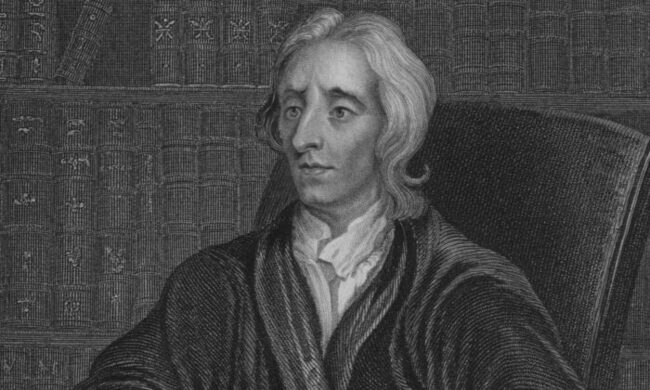


Above: The English philosopher John Locke was one of many sources for the Declaration
This essay first appeared in the May 30, 2026 Epoch Times. This is the fifth installment in a six-essay series on the Declaration of Independence, written in honor of its 250th anniversary. Read part I here, part II here, part III here, and part IV here.
In his book, “Inventing America,” the liberal scholar Garry Wills argued that the Declaration owed much to previous Anglo-American history. This is correct.
English parliamentary bills originated as petitions by the people’s representatives to the king. These petitions listed grievances and requested relief. When the king assented to a petition, it became law.
During the 1760s and early 1770s, American conventions and legislatures sent a series of petitions to the king. They followed the form of listing grievances and requesting relief.
The Declaration follows much the same pattern—except that after its list of grievances, it requests nothing. Instead, it makes an announcement.
The Declaration also owes much to the English Declaration (or Bill) of Rights of 1689. After an uprising forced the oppressive King James II to flee Britain, an informal parliament (“convention parliament”) issued the Declaration of Rights to proclaim:
* a list of some of the core rights of Englishmen;
* that they believed that William of Orange and his wife Mary Stuart, would respect those rights; and
* that, with that understanding, “the Lords Spiritual and Temporal and Commons … do resolve that William and Mary, prince and princess of Orange, be and be declared king and queen of England …”
Natural Law
Although the Declaration did not itself create law, it did have some legal implications. The second paragraph—the portion laying out the Founders’ assumptions—makes important assertions about natural law. God created men (i.e., people) to be legally equal. He endowed them with certain rights (in this context, a synonym for “powers”). Although some of these rights/powers are alienable (transferable) and may be handed over to the government, others—life, liberty, and the pursuit of happiness—are not. People give governments alienable rights/powers so that the government may protect the unalienable ones.
Moreover, governments have only those powers that the people, by consent, have given them. When a government no longer serves its rightful purpose, the people may reorganize or remove it.
‘Nations,’ Not ‘Nation’
Advocates for an unlimited federal government sometimes argue that it inherited powers from the Continental Congress outside the Constitution, and therefore is not limited by the Constitution. In various respects, this argument is deeply flawed. One of its principal flaws is that it relies heavily on the claim that the states were never fully sovereign and that the Continental Congress exercised its own sovereign authority.
But as Wills also notes, however, the text of the Declaration disproves this. It did not announce the emergence of a single new nation, but of thirteen. In its reference to the “united States,” the initial “u” is small, but the initial S is large. The language of the Declaration’s final and “operative” portion is:
That these United Colonies are, and of Right ought to be Free and Independent States … and that as Free and Independent States, they have full Power to levy War, conclude Peace, contract Alliances, establish Commerce, and to do all other Acts and things which Independent States may of right do.
‘People,’ Not ‘Peoples’
On the other hand, you may notice that the Declaration treats Americans as a single “People” rather than as thirteen separate ones: “When in the Course of human events, it becomes necessary for one people [i.e., the Americans] to dissolve the political bands which have connected them with another [i.e., the British] …”
Of course, there is nothing unusual about a single people being divided into multiple sovereignties. When Thomas Jefferson wrote those words, the German people—or, if you prefer, the German ethnic group—was divided among the many sovereignties of the Holy Roman Empire. In fact, Germans lived under separate sovereignties until 1870, and throughout much of the 20th century as well. Today, this remains true of Koreans, Arabs, and many other discrete “peoples.”
For reasons I explain in “The Original Constitution,” the formulation in the Declaration of Independence—a single people governed by thirteen new sovereign states—is important for understanding why the Constitution could become effective after approval by only nine states, rather than all thirteen.
The Declaration presents other fascinating questions: Exactly what did it mean by characterizing humans as “equal”? Why did Congress soften the harsh language about the slave trade that Jefferson included in his first draft? And what immediate effect did the Declaration have? (That question is treated in the sixth and final installment in this series).
But another question is easily answered: Does the Declaration still matter? And the answer to that is clear: It remains one of the four most influential secular documents in Western political history: Magna Carta, the Digest of Justinian, the U.S. Constitution, and the Declaration of Independence.